2026 Rutherford Cabernet Sauvignon, Clone 169: Bright Berries, Serious Napa Power
Rutherford
Cabernet Sauvignon.
Bright berries. Serious Napa power.
Beautifully ripe, concentrated Cabernet with the brightest berry character of our three Rutherford selections. Here is how we would bring that fruit into balance—and into the cellar.
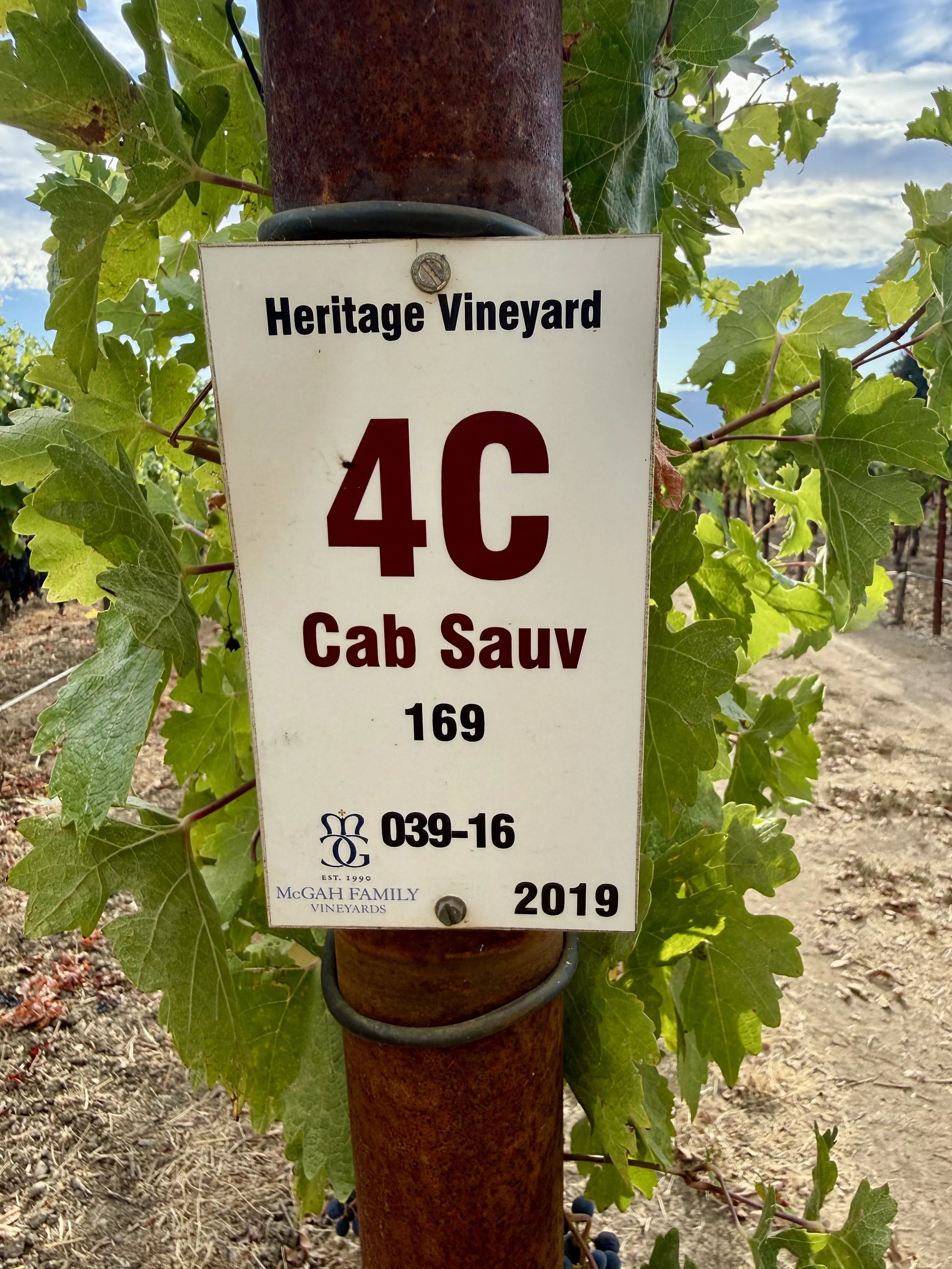
McGah Family Heritage Vineyard · Block 4C · Napa Valley
Original ETS-derived values · October 8, 2026 · View the analysis. Worked recipe: 27.4° → 26° Brix.
Your first Clone 169 Cabernet.
For a powerful dry Cabernet that keeps the ripe berries in focus, start here. This is a one-pail example at 26° Brix, not a substitute for measuring your own must. Water adjustment, pH correction and nutrition are three separate decisions.
From frozen must to wine
Thaw, then mix from the bottom up
Sanitize your equipment and thaw the pail under clean, controlled conditions. Before taking a Brix, pH or TA reading—and before making any additions—mix the thawed must thoroughly from the bottom upward. Get your paddle or spoon all the way to the bottom and keep mixing until the pail is uniform.
During freezing, sugar and acids can become concentrated in the remaining liquid and collect toward the bottom of the pail, sometimes as a clearer, heavier layer. If you sample before remixing, the reading may not represent the entire pail. Once the must is homogeneous, transfer to a primary vessel with at least 25% headspace for the cap and foam, and inoculate promptly once ready.
Prepare the water and the two acid portions
Use low-mineral water that is chlorine- and chloramine-free. Plain distilled water with no minerals added is the easiest option. Unsure what kind of water to use? See the water guide →
For one 5-gallon must pail with an estimated 3.5 gallons of liquid, our working target is 26° Brix—about 16% potential alcohol. Measure 0.19 gal (0.71 L) of suitable water. Weigh about 4 g tartaric for that water, plus our recommended 27 g for the must's pH correction: approximately 31 g total.
Bench-test this combined treatment on representative must before treating the full batch. Both acid portions may be dissolved together in the measured water and blended into the must. The 27 g is part of the 31 g total, not another addition afterward.
Mix, wait, then recheck Brix and pH
Mix thoroughly, wait 15–30 minutes, then take a representative sample and recheck Brix, pH and TA. Our working pH target is 3.60. The 27 g recommendation comes from the WGD calculator's balanced one-shot for the original pH 3.92 sample; it does not guarantee that the combined treatment reaches 3.60 or stays above 3.50.
If a further adjustment is needed, re-enter the new measured pH and actual liquid volume in the full calculator, then confirm a smaller follow-up with a bench trial. Do not blindly repeat the original 27 g dose. Continue checking during fermentation and after MLF.
Rehydrate and inoculate the yeast
Pick 5 g RP15 or BDX. If you have Go-Ferm Sterol Flash, follow that specific label, not an older hot-water Go-Ferm procedure. For 5 g Flash, a tenfold water ratio uses about 50 mL of separate clean, chlorine- and chloramine-free water at or above 59°F (15°C); refer to the manufacturer's yeast-to-nutrient dosage and rehydration timing. Never put DAP in the rehydration water. Do not use the tartaric-acid water-back solution for yeast rehydration.
Add structure support and early nutrition
Opti-Red: 5 g near inoculation. FT Rouge: optional, up to 7 g if you want extra color/tannin support, but the grapes already have plenty of substance. For the RP15/BDX working nutrient example, split 5 g Fermaid O and 8 g DAP into two early feeds: 2.5 g + 4 g after a 2–3° Brix fall, then again near one-third sugar depletion. Add separately in suspension, carefully, because must can foam; never attempt a big late DAP catch-up.
Ferment for fruit, not just extraction
Start around 70–78°F, within your yeast's specified operating range. Track temperature and sugar every day. Gently wet the cap about two or three times daily. Taste as you go: we want that beautiful berry character along with tannin and length, not an unnecessarily harsh finish.
Press, finish MLF, and age
Press once you have the extraction and dryness you want. Measure again after primary fermentation. For a dry Cabernet, complete and verify malolactic fermentation if that is your plan, then reassess pH/TA and establish appropriate SO2 management. Oak can add dimension, but do not bury the fruit. Confirm stability analytically before bottling.
Dimpled. Concentrated. Ready.
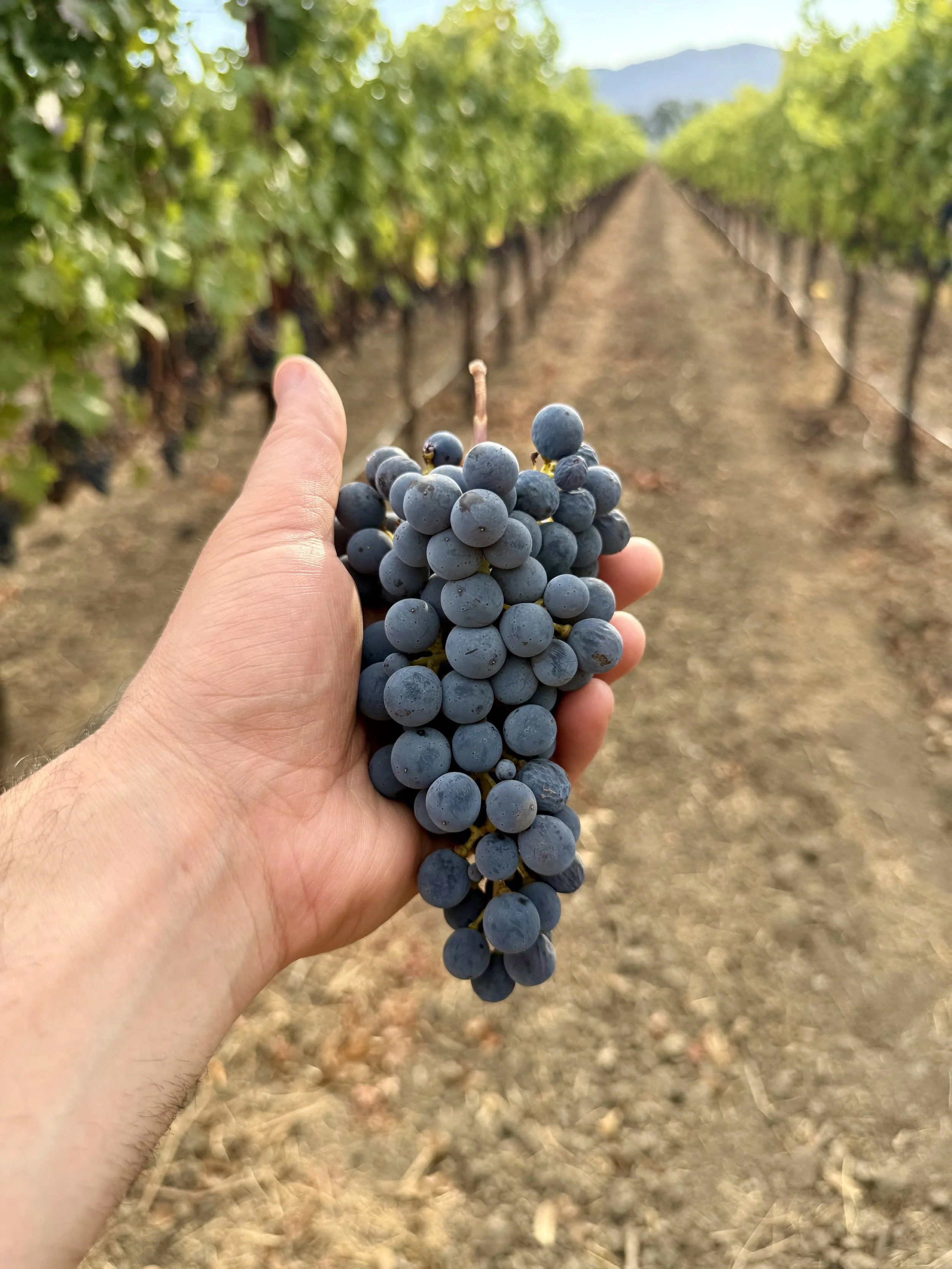
All three Rutherford Cabernets came in just beginning to dimple: deeply ripe, concentrated and full of flavor. To me, this was exactly the fruit for a big, powerful Napa-style Cabernet.
The Heritage Clone 169 stood out for its bright, ripe berry character. We tasted it at crush. That flavor was already there; our job is to carry it through fermentation and aging, not cover it up.
These vines were planted in 2019, compared with the 2009 and 2010 plantings behind the other two selections. Their relative age might be part of the difference, but clone, block and growing conditions also matter. We cannot attribute the flavor to vine age alone.
Harvest impressions from Wine Grapes Direct; the winemaking outcomes are our intended direction, not a guarantee.
McGah Family Heritage Vineyard, Rutherford AVA. Farmed by Garvey Vineyard Management.
Three Cabernets. One remarkable harvest.
Ferment them separately to learn what each selection contributes, then compare them at the blending bench. All three shared the ripeness and concentration we wanted this year.
Clone 169 · planted 2019
Our brightest berry impression at crush. Ripe cassis, fresh blackberry, black cherry and the concentration for a serious, structured wine.
Winemaking emphasis: let the fruit shine.
ENT685 · planted 2009
An older Rutherford planting with its own clone, rootstock and block character. Make it separately before any blending decision.
Winemaking emphasis: discover its individual expression.
Clone 7 · planted 2010
Another mature vineyard block that makes an ideal side-by-side comparison with both ENT685 and our younger Clone 169.
Winemaking emphasis: taste, compare and blend later.
I would love to see someone ferment all three independently and make blending trials. You could end up with three individual vineyard-clone wines, a multi-clone Cabernet, or both. You do not even have to reach for Merlot or Malbec to create a more layered Cabernet blend. And if you do want those varieties later, Rutherford gives you plenty of directions to go.
The concentration is already there.
A modest water-back from 27.4° to 26° Brix does reduce the initial concentration of dissolved components. But we are starting with such mature, flavorful grapes that the small adjustment is not the same thing as making a weak wine. Color, tannin and many texture-building compounds will continue to be extracted from the skins.
Protect the berry expression
Choose a yeast that supports ripe fruit and a controlled fermentation temperature. RP15 is a good fit for berry and spice; BDX is a classic structural option. Avoid letting a vigorous ferment become unnecessarily hot if your goal is to keep that lifted berry impression.
Not every great Cabernet needs the longest maceration or the heaviest oak.
Let the skins do their work
Manage the cap consistently, taste the fermenting must, and use heat or extended skin contact only when you actually want greater tannin extraction. A more powerful aging style may support more time and a firmer oak program; a fruit-forward bottling may benefit from earlier pressing.
Extraction should support fruit, not cover it up.
At 26° Brix, the 70%-liquid one-pail example needs only about 0.19 gal water. That is roughly a 5% increase in initial liquid volume, not a wholesale change in the grape's identity. It does lower potassium concentration modestly, which can be helpful for acid work, but 1,850 mg/L potassium still makes bench trials essential.
The numbers behind the plan.
These are the measured pre-adjustment numbers from the October 8, 2026 ETS analysis for Cabernet Sauvignon Clone 169. They describe the must before water-back, tartaric, fermentation or MLF. They are not projections of the finished wine.
| Analyte | Measured result |
|---|---|
| Brix | 27.4° |
| Glucose + fructose | 288 g/L |
| pH | 3.92 |
| Titratable acidity (TA) | 3.6 g/L |
| Potassium | 1,850 mg/L |
| Yeast-assimilable nitrogen (YAN) | 84 mg N/L |
| L-malic acid | 1.99 g/L |
| Tartaric acid | 4.1 g/L |
| Volatile acidity (acetic acid) | 0.22 g/L |
| Ammonia | 27 mg/L |
| Alpha-amino compounds (as N) | 62 mg/L |
Figures above are transcribed from the ETS-derived customer-facing summary. The image below is that transcription, not an unaltered ETS laboratory PDF.
View the Cabernet Clone 169 laboratory-results image

Brix & sugar: why 26° makes sense
Our worked WGD calculator example starts at the reported 27.4° Brix and targets 26°. Using the measured 288 g/L glucose + fructose and approximately 17 g/L fermented sugar per 1% alcohol, the undiluted estimate is 16.9% potential ABV. Applying the 27.4 → 26 dilution gives approximately 273 g/L and 16.1% potential ABV—about 16%. At a 25° target from the same 27.4° starting input, the estimates are 263 g/L and 15.5%. Measured glucose + fructose remains an independent input; changing Brix does not create a new laboratory sugar result. Actual alcohol must be measured.
pH & TA: the bigger adjustment
At pH 3.92 and TA 3.6 g/L, acid balance cannot be an afterthought. Our reference recipe recommends 27 g additional tartaric per pail, beyond the approximately 4 g used to acidulate the water. We are aiming for pH 3.60, with TA, taste and MLF in mind. Confirm the combined treatment with a bench trial and measurements; pH is not interchangeable with TA.
Potassium: why bench trials matter
The measured 1,850 mg/L potassium flags a potentially strongly buffered must, but potassium alone does not predict the response to acid. Dilution lowers its concentration only modestly. Our 27 g recommendation is a lot-specific starting treatment; use actual pH/TA measurements to judge it and any follow-up.
YAN: protect the fermentation
84 mg N/L is low for a 26° Brix Cabernet. The water-backed example is about 80 mg N/L before nutrients. RP15 and BDX are medium-demand choices; high-demand strains warrant a more substantial plan. Use organic nutrition plus carefully scheduled inorganic nitrogen where appropriate, not an unplanned late DAP dump.
Malic & tartaric acids
1.99 g/L L-malic acid means malolactic fermentation may noticeably affect the acid balance and pH. The starting 4.1 g/L tartaric is only part of the picture; it does not tell us directly how much added tartaric will be required. Verify MLF completion before final adjustments and bottling.
VA and nitrogen components
Starting VA of 0.22 g/L provides a baseline. Ammonia (27 mg/L) and alpha-amino nitrogen (62 mg/L) are components of the nitrogen picture; use the reported total YAN of 84 mg/L for the initial nutrition discussion. Do not infer fermentation health from any single number.
Everything in the table is a reported lab number. Predicted 16% alcohol, water-addition volumes, projected YAN after dilution, yield and tartaric trial doses are illustrations. The must you ferment is the must you need to measure.
Find your balance.
Our worked recipe aims at 26° Brix and about 16% potential alcohol. Compare the 26° reference with a 25° alternative, estimate the water, and keep water-preparation acid separate from the additional pH dose. Chemistry and yield outputs are estimates; the 27 g recommendation is tied to the reference recipe, not a live pH prediction.
Water note: use low-mineral, chlorine- and chloramine-free water. Unsure what kind to use? See the water guide →
Juice fraction & laboratory assumptions
Changing Brix does not invent a new glucose + fructose result. The sugar and YAN fields remain independent laboratory assumptions. Default liquid fraction: 70% of a 5-gallon must pail.
- Additional tartaric for must pH
- 27 g
- Combined tartaric, including water prep
- About 31 g
One reference pail: about 4 g for the water + 27 g for must pH = about 31 g total. The 27 g is included in that total, not added again.
Target pH 3.60; verify by measurement. Bench-test the combined water/acid treatment, dissolve fully, mix thoroughly and wait 15–30 minutes before retesting. It is not a guaranteed pH endpoint or a guarantee against overshooting. Do not repeat the original 27 g without new measurements and a new trial.
Reference: 27.4 → 26° Brix; 70% projected liquid; original pH 3.92, potassium 1,850 mg/L. This panel scales the same-lot recipe by pail count only. Changed chemistry or dilution settings require a new pH assessment, so a combined acid total is not shown for them.
Yield & bottle estimates
Model: initial sugar 288 g/L; 17 g/L per 1% alcohol; 3.5 gal original juice; 75% water retention. These are estimates.
About the added bottles
The small increase at 26° is a bonus, not a guarantee. Real yield depends on press fraction, skins, lees and racking. Our goal is balance.
About acid, potassium and fruit
The water reduces potassium concentration a little; it does not settle the pH question. Our 27 g per-pail recommendation is a starting plan for this specific lot. The actual mixed-must pH and TA decide whether anything further is needed. Protect the bright berry character rather than chasing a calculator number without tasting and measuring.
Choosing water for your adjustment.
For most people, the simple answer is easy: plain distilled water with no minerals added. If you are using tap, RO, spring, filtered or another source, the details below explain what to check.
Unsure what kind of water to use? Open the full water guide
For water-back, use water that is safe to drink, low in minerals, low in alkalinity, chlorine-free and chloramine-free. Do not assume that any bottled water, or anything that has passed through a filter, meets those requirements.
What to buy
The simplest choice: a sealed jug of plain distilled water sold for drinking or food use, with no minerals added. Examples of the exact product type:
- Great Value Distilled Water, 1 gallon — Walmart.
- Good & Gather Distilled Water, 1 gallon — Target.
Read the actual jug, not just the brand name. These are distilled-water examples, not endorsements of every water those brands sell. Check the label and supplier information if anything is unclear.
Reverse-osmosis (RO) water can also work when the finished water is suitable for drinking, low-mineral and chlorine-/chloramine-free, with no minerals added back. Check the supplier or the complete treatment system, not just the words “RO” or “purified.”
What not to grab by mistake
Skip mineral water, alkaline water, electrolyte water, and water labeled “minerals added for taste” for this recipe. Spring water is not our default; its mineral content and alkalinity need checking first.
“Purified” does not mean “no added minerals.” Check the ingredients for added mineral salts. Even “vapor distilled” is not enough: smartwater adds electrolytes after distillation. For this recipe, choose plain distilled water without that mineral addition.
Letting tap water sit overnight does not reliably remove chloramine. Do not rely on a quick boil or an unspecified pitcher/refrigerator filter, either. Use a verified treatment or buy suitable water.
This is about choosing water for winemaking, not a claim that properly treated municipal drinking water is unsafe.
Using city, well or filtered water? Check this first
Ask your local water utility: “Are you using chlorine or chloramine right now? Can you send the current water-quality report, plus hardness, total alkalinity and total dissolved solids (TDS)?” Ask for any values missing from the report; treatment can change seasonally. How to get your water report.
Check minerals and disinfectants separately. Alkalinity is the water's ability to neutralize acid; water pH alone does not tell you that capacity. A low TDS reading does not prove that chlorine or chloramine is absent. For treated tap water, verify the finished water with an appropriate total-chlorine test that includes combined chlorine, not a free-chlorine-only check. Free versus total chlorine explained.
Match the treatment to the source. A filter's chlorine-reduction claim is not automatically a chloramine-reduction claim. Check its rated performance, flow and replacement schedule. A standard water softener is not a substitute for demineralization, and carbon treatment does not by itself establish low mineral content. RO systems may also have a remineralizing stage; do not use that added-mineral output for this recipe.
Well water still needs checking. Confirm that it is safe to drink and check its minerals and alkalinity. No municipal disinfectant does not automatically make it suitable. When you cannot establish the water quality, use the plain food-use distilled-water option above.
For yeast rehydration, follow the exact yeast/Go-Ferm product protocol using a separate portion of clean, chlorine- and chloramine-free water. Never use the tartaric-acid water-back solution to rehydrate yeast.
Why these checks? Alkalinity can neutralize added acid, while chlorine/chloramine can create fermentation and taint risks. References: AWRI water-addition guidance; USGS alkalinity; CDC disinfectants; CDC treatment systems. All water references.
Bright fruit. Serious structure.
Both approaches make a fully dry, powerful Napa-style Cabernet. The difference is emphasis: bring the bright berry character forward, or build a more structured wine for the cellar. Yeast, extraction, fermentation temperature and oak shape that choice. Both begin with an intentional pH plan.
Choose the character. Respect the limits.
Clone 169 already tastes richly ripe and berry-driven. Use this selector to compare fruit-forward choices such as RP15 or D21 against classic structured Cabernet options such as BDX, D254 and CLOS. The alcohol ratings are supplier guidelines, not guarantees at 16% ABV; match nutrients, temperature and a realistic target to your strain.
Enoferm RP15
Ripe fruit, spice and a full mid-palate.
- Published alcohol tolerance
- 17%
- Fermentation temperature
- 68–86°F / 20–30°C
- Nitrogen demand
- Medium
- Fermentation pace
- Moderate
Why we’d consider it:
Upside
Watch-outs
Nutrient guidance & manufacturer notes
Alcohol tolerance and temperature are supplier specifications, not guaranteed results or an automatic fermentation stopping point. The fit, upside and watch-outs are our interpretation for this fruit. Selecting a strain here does not silently change the beginner recipe.
Read the manufacturer’s full specificationsThe advertised alcohol tolerance is a performance limit under suitable conditions, not a guarantee of fermenting this must dry. Yeast strain influences flavor and texture but does not replace fruit quality, fermentation temperature, oxygen management, and nutrient planning. Manufacturer specifications are linked on every card. We don't claim to have personally trialed every strain listed here.
Compare all 10 yeast strains
Yeasts shown: 10
Enoferm RP15
FRUIT-LED PICKripe fruit · spice · full mid-palate
- Alcohol tolerance
- 17%
- Temperature
- 68–86°F
- Nitrogen demand
- Medium
My first pick to preserve the bright ripe berry character of Clone 169 while adding a complete mid-palate.
Upside & watch-outs
Upside: A natural fit for bright ripe berry fruit, balanced spice and substantial body.
Watch-outs: At 26 Brix, the margin over a 16% wine is small; its 17% rated tolerance still is not a fermentation guarantee. Feed this YAN-deficient must carefully.
Uvaferm BDX
CLASSIC CABERNETjammy fruit · spice · classic structure
- Alcohol tolerance
- 16%
- Temperature
- 64–86°F
- Nitrogen demand
- Medium
Our familiar Bordeaux-style workhorse for a traditional Napa Cabernet, with structure, cassis and spice.
Upside & watch-outs
Upside: A sensible standard for seriously ripe Cabernet and a sound choice after water and acid balancing.
Watch-outs: The 16% supplier tolerance is close to the projected 16.1% potential alcohol at 26 Brix. Consider 25 to 25.5 Brix or a higher-tolerance strain if dryness is essential.
Lalvin ICV D21
aromatic freshness · berry · balanced palate
- Alcohol tolerance
- 16%
- Temperature
- 59–82°F
- Nitrogen demand
- Low
A very interesting way to emphasize lifted fruit and fresher red-berry impression from ripe Cabernet.
Upside & watch-outs
Upside: Potential freshness without sacrificing substantial Cabernet fruit.
Watch-outs: Watch nutrient and temperature stress; D21 has a supplier warning about VA under stress.
Lalvin ICV D254
ripe plum · roundness · weight
- Alcohol tolerance
- 16%
- Temperature
- 54–82°F
- Nitrogen demand
- Medium
Plush, rounded mouthfeel and generous dark-fruit character; a different stylistic direction from the bright-berry plan.
Upside & watch-outs
Upside: Layered plum and dark berry flavor with fullness.
Watch-outs: More roundness is not necessarily better than preserving the original clean berry note.
Lalvin BM4x4
jam · cherry liqueur · warm spice
- Alcohol tolerance
- 16%
- Temperature
- 64–82°F
- Nitrogen demand
- High
A complex, oak-friendly structured red approach for an experienced winemaker with a tailored nutrition plan.
Upside & watch-outs
Upside: Complexity, color and generous mid-palate.
Watch-outs: High nitrogen demand is a major consideration in this 84 mg/L YAN must. Do not copy the RP15/BDX recipe.
Lalvin CLOS
berry · mid-palate · ageable tannin
- Alcohol tolerance
- 17%
- Temperature
- 55–90°F
- Nitrogen demand
- Medium
A structured, berry-focused red-wine option that can express plenty of fruit without losing tannin strength.
Upside & watch-outs
Upside: Berry character, tannin and a full mid-palate.
Watch-outs: Temperature shifts can change fermentation pace; follow the cap closely.
Lalvin T73
ripe berries · plums · fruit-forward
- Alcohol tolerance
- 16%
- Temperature
- 65–90°F
- Nitrogen demand
- Low
A low-demand fruit-led yeast worth considering for ripened Cabernet, still with a complete nutrient plan.
Upside & watch-outs
Upside: Ripe berries and plum with a medium-to-full palate.
Watch-outs: Supplier tolerance is 16%; the 26 Brix modeled potential is close to this, so leaving residual sugar is possible without a plan.
Uvaferm 43
red berries · color · fructose fermentation
- Alcohol tolerance
- 18%
- Temperature
- 55–95°F
- Nitrogen demand
- Low
A more resilient high-sugar or fructose-focused fermentation option, not necessarily my top berry-expression pick.
Upside & watch-outs
Upside: Useful fructose use when working close to a strain tolerance limit.
Watch-outs: Fast fermentation and high alcohol tolerance do not replace temperature control, nutrition and verification of a dry finish.
Lalvin EC-1118
neutral profile · fast · reliable
- Alcohol tolerance
- 18%
- Temperature
- 50–86°F
- Nitrogen demand
- Low
A reliability-focused, fairly neutral fermentation option if getting dry and through a difficult fermentation comes before varietal expression.
Upside & watch-outs
Upside: Neutral character leaves the grapes themselves in focus.
Watch-outs: May make unwanted SO2 under low-YAN stress and complicate MLF; manage nutrition carefully.
Enoferm Syrah
plum · violet · peppery spice
- Alcohol tolerance
- 16%
- Temperature
- 59–90°F
- Nitrogen demand
- Medium
A savory, peppery, floral alternative for somebody who wants to explore beyond a classic Cabernet fermentation.
Upside & watch-outs
Upside: Can contribute lifted floral notes and attractive spice.
Watch-outs: Not my first choice if the goal is simply to preserve the Clone 169 berry personality; it will not change Cabernet into Syrah.
What to add, how much, and when.
For the 26° Brix fruit-forward dry-Cabernet route, think in separate jobs: acid to bring chemistry into range, rehydration nutrient to give yeast a strong start, nitrogen during fermentation, and optional tannin/color support. Our usual 5 g Fermaid O and Opti-Red portions can be used, but the 84 mg/L starting YAN means the nutrient plan needs extra attention.
Reference batch: one 5-gal must pail, 3.5 gal juice assumption, plus about 0.19 gal prepared water = 3.69 gal (14.0 L) of liquid. Actual pail yield and additions change the dose calculations.
Yeast: RP15 or BDX
- One-pail example
- 5 g
- When
- At inoculation
RP15 is our fruit-led first choice; BDX gives a classic structured Bordeaux-style direction. Choose one, rehydrate correctly and inoculate promptly after must prep.
Go-Ferm Sterol Flash
- Standard kit portion
- 5 g
- When
- Yeast rehydration
Use the specific Sterol Flash instructions, not older hot-water Go-Ferm directions. Its published dosage recommendation and the supplied 5 g portion are separate concepts.
Fermaid O
- Standard kit portion
- 5 g total
- When
- 2.5 g + 2.5 g early
One portion after a 2–3° Brix fall; a second at approximately one-third sugar depletion. Suspend before addition. In this low-YAN must, 5 g Fermaid O alone should not be assumed sufficient.
DAP / inorganic nitrogen
- Working RP15/BDX example
- ~8 g total
- When
- 4 g + 4 g early
An illustrative companion to 5 g Fermaid O for this 14.0-L, 26° Brix batch, not an all-strain prescription. DAP is not automatically in the kit. Use wine-grade DAP, respect product limits, and adjust to yeast nitrogen demand and your actual YAN. No DAP in rehydration water; avoid late catch-up additions.
Opti-Red
- Standard kit portion
- 5 g
- When
- At inoculation
Supports color and mouthfeel; it does not replace yeast nutrition. Ripe Cabernet has plenty of raw material already, so this is polish, not a substitute for good extraction choices.
FT Rouge
- Typical available portion
- Up to 7 g
- When
- Early fermentation
Optional early color and tannin support. Taste your own lot and follow the label; don't automatically add maximum tannin to fruit this concentrated.
Tartaric acid & water prep
- For 0.19 gal added water
- About 4 g
- Recommended additional pH dose
- 27 g per pail
About 31 g total for this reference recipe. Dissolve both portions in the measured 0.71 L of water and blend thoroughly; do not add the 27 g a second time.
For the original pH 3.92 lot, our working target is 3.60. Bench-test the combined treatment, wait 15–30 minutes after mixing, and remeasure pH/TA before further additions. This is a lot-specific recommendation, not a universally safe one-shot dose.
Optional: Stimula Cabernet
- Supplier reference dose
- 40 g/hL
- 14.1 L equivalent
- ~5.6 g
A targeted fruit-ester nutrient from Scott Laboratories. Use at about one-third Brix drop as part of a redesigned nutrition plan, not casually on top of all other nutrients. Supplier details.
SO2 & MLF culture
- When
- Stage-dependent
- Dose
- Use analysis
High starting pH makes microbial management crucial. Verify malolactic status, monitor free SO2 and pH, and do not bottle based on a calendar date.
The Scott Labs nutrition planner accounts for Brix, strain nitrogen demand, temperature and fermentation goals. Recalculate if you choose high-demand BM4x4, change your water-back, or obtain a new YAN reading. Organic nutrition and DAP are not gram-for-gram interchangeable.
Finish the wine, not just the fermentation.
The wine after fermentation is not the must in the ETS report. The pH, TA, alcohol and free SO2 that matter for bottling need to be measured in the finished wine.
Dry Cabernet & MLF
We would normally plan on malolactic fermentation for a classic dry Cabernet. The original 1.99 g/L malic acid matters because MLF can raise pH. Start with a sound pre-MLF acid plan, verify MLF completion analytically, and fine-tune afterward as needed. Protect the wine from oxygen and spoilage through measured SO2 management.
Measure the wine you actually made: pH, TA, alcohol, residual sugar, free and total SO2 as appropriate, and confirmed MLF status. Good grapes deserve a properly finished wine.
Let oak frame the fruit.
Clone 169 has plenty of ripe Cabernet concentration to carry oak, but the bright berries are the part I most want to protect. For the fruit-forward style, I would start conservatively and taste frequently. For the bigger cellar-worthy style, more structure and an appropriate oak program may be justified after you taste the finished ferment and MLF-adjusted wine.
Do bench trials. Oak chips, cubes, staves and barrels extract differently; batch volume, toast, origin, contact time and the wine's tannin level all matter. You can add oak. You cannot easily take it out.
A practical oak worksheet
Batch volume · oak format · oak origin · toast level · dose range · contact time · tasting notes.
Our dedicated oak calculator is still in development; this is not an active oak-dose calculator.
Your cellar. Your notes.
What did you think of the juice? How are you making your wine? Whether this is your first batch or your fiftieth, we'd love to see what you do with our 2026 Rutherford Cabernet Clone 169. Tell us what you know, skip what you don't, and come back with updates.
Write your notes or share a video
Share your starting chemistry, first impressions, yeast choices, and anything interesting that's happened along the way. Measurements are optional.
No account needed. Fill this out, then open the prepared email draft and send it from your usual email app.
- 1. Your batch
- 2. The details
- 3. Review & email
Make your own Rutherford Cabernet.
McGah Family Heritage Vineyard · Rutherford AVA · five-gallon crushed grape must. See the current listing for availability, laboratory information and fulfillment updates.
Sources & calculation assumptions
Grape chemistry: ETS Laboratories, analysis dated October 8, 2026, transcribed in the customer-facing Clone 169 lab summary above. All laboratory measurements are from the original pre-adjustment juice sample.
Our winemaking estimates: the worked example uses Wine Grapes Direct's corrected 27.4° → 26° Brix inputs, one 5-gallon must pail and 3.5 gallons projected liquid. The volume-based model is reproduced here for the WGD winemaking calculator: water = 3.5 × (27.4 / 26 − 1) = 0.1885 gal (0.7134 L), rounded to 0.19 gal / 0.71 L. At 6 g/L of added water, the water-preparation portion is 4.28 g tartaric, rounded to about 4 g. With the separate recommended 27 g pH portion, the combined amount is 31.28 g, rounded to about 31 g. The recipe rounds acid to whole grams; the interactive tool displays one decimal (4.3 g for the water and 31.3 g combined). Using 288 g/L starting glucose + fructose gives 273.28 g/L after dilution and 16.08% potential ABV (about 16.1%) with the approximate 17 g/L-per-1%-ABV planning factor. The 25° alternative uses the same 27.4° starting input. One-pail liquid fraction is assumed 70%, and 75% of added water is assumed retained at bottling. This simplified dilution model ignores density differences. Brix, alcohol and pH must still be measured.
Acid recommendation: Wine Grapes Direct's worked calculator example for one 5-gal must pail, 3.5 gal projected liquid, Brix 27.4 → 26, pH 3.92 → 3.60, big-red style floor 3.50, potassium 1,850 mg/L and a 40 g pH-addition cap returned a 27 g balanced one-shot. That is the additional pH portion recommended in this guide. The cap and floor are model settings, not analytical guarantees. The separate water-preparation portion must also be counted in the combined treatment.
Acid response and verification: Scott Laboratories' hot-fruit guidance discusses high potassium/pH and the need for bench trials. Our recommendation applies to the stated lot and measurements; measure the actual blended must and verify again during fermentation and after MLF.
Yeast & nutrients: individual yeast supplier profiles (links in the selector), Scott Labs Fermentation Nutrition Planner, Yeast Nutrition 101 and Stimula Cabernet. Suggested nutrients need adjusting for measured must volume, Brix and yeast strain.
Water-quality guidance: Australian Wine Research Institute: water addition recommends removing chlorine/chloramines from must-addition water to reduce fermentation problems and taint risk. USGS: alkalinity and water explains acid-neutralizing capacity. CDC: chlorine and chloramine covers utility treatment, seasonal changes and why standing does not remove chloramine. EPA archived chloramine guidance also cautions against relying on boiling. EPA: obtaining your Consumer Confidence Report explains how to request your utility's water report. CDC: home water treatment systems explains that treatment performance is system-specific; no generic filter label proves all requirements are met.
Buying examples: Great Value Distilled Water, 1 gallon (Walmart) and Good & Gather Distilled Water, 1 gallon (Target). These links identify a product type; no price, stock availability or batch-specific laboratory guarantee is asserted. Check the current jug label and supplier details; select plain distilled water suitable for food/drinking use with no added minerals. An example of purified water with minerals added illustrates why the word “purified” alone is insufficient.
Yeast water: Scott Laboratories: Go-Ferm Sterol Flash rehydration protocol. Use a separate water portion and follow the exact product directions; the tartaric-acid dilution solution is not the yeast-rehydration water. Water references checked October 15, 2026.
Field observations: the description of dimpled, fully ripe fruit and the notably bright berry character of Clone 169 is Wine Grapes Direct's direct 2026 harvest impression. Vine age is one possible influence, not an established causal explanation.
Educational guidance for home winemakers, not an analytical guarantee. Follow product labels and local regulations. Always measure fermentation chemistry and confirm stability before bottling.
Vineyard photographs: Wine Grapes Direct's supplied IMG_7395.jpeg and IMG_7394.jpeg, also used on the Heritage Clone 169 listing. The photographs are displayed without retouching or cropping.