Making the 2025 Napa Calistoga Cabernet Sauvignon – Winemaker Guide
If you’re setting out to make a truly top-tier Cabernet this season, you’re in the right place. And if you’ve already ordered our 2025 Calistoga Cabernet frozen must — or you’re about to — congratulations. You’re working with Benchland fruit that delivers the best of both worlds: generous berry character from the valley floor, with the structure and earthiness you expect from hillside influence.
This vintage leaned cooler overall across the valley, giving us something very reminiscent of a Bordeaux-style year — full flavor development without heat-driven overripeness. That balance gives you real freedom in your extraction choices.
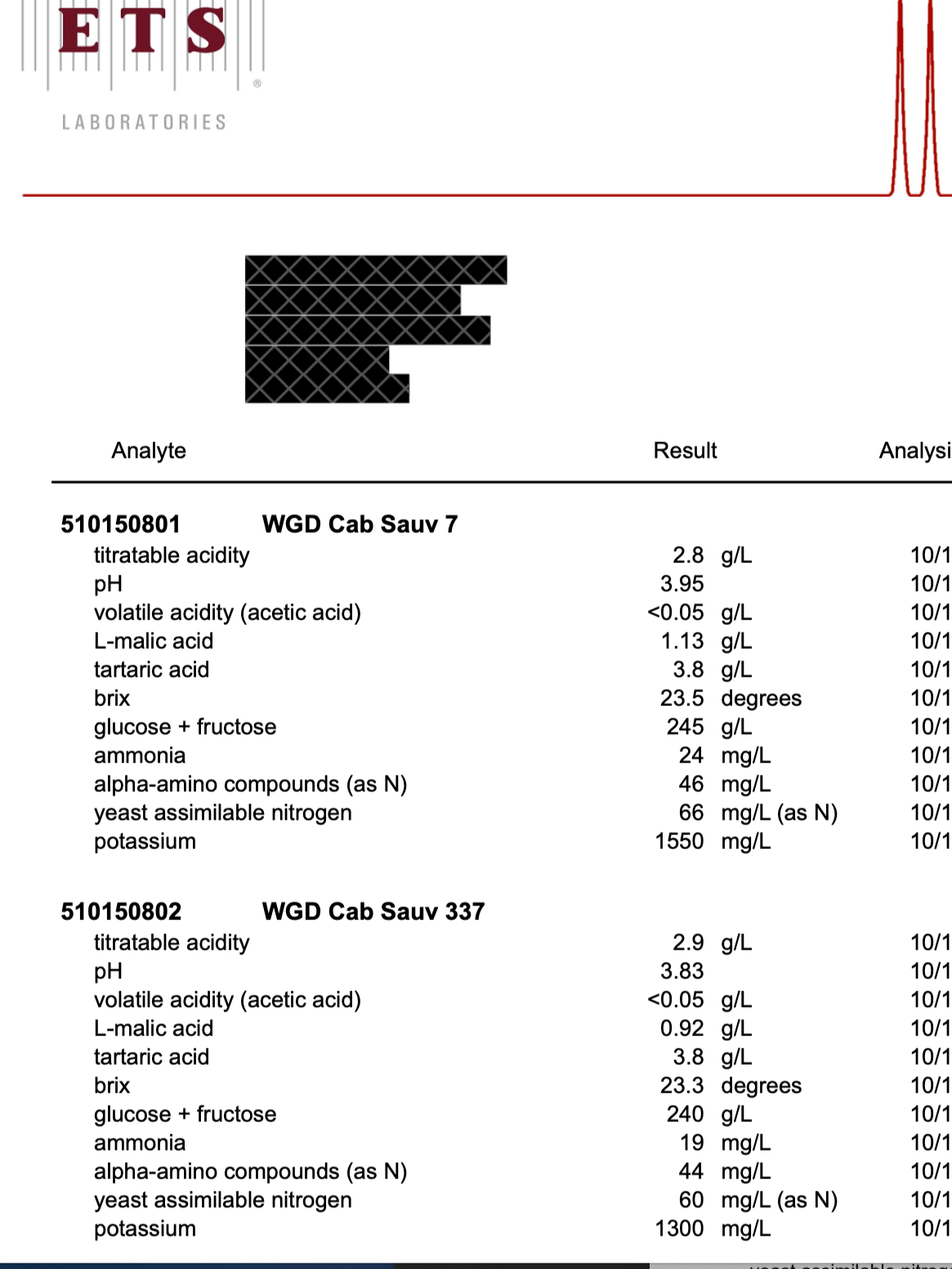
Lab highlights (ETS analysis)
Cabernet Sauvignon – Clone 7
Brix: 23.5
pH: 3.95
TA: 2.8 g/L
YAN: 66 mg/L
Cabernet Sauvignon – Clone 337
Brix: 23.3
pH: 3.83
TA: 2.9 g/L
YAN: 60 mg/L
In practical terms, this means:
fully flavored Cab at moderate Brix
higher pH than ideal for long-term stability
low YAN → plan on nutrition support
excellent color and flavor potential without chasing heat
Quick Winemaker Summary (Read This First)
Calistoga Cabernet Sauvignon – Clones 7 & 337
Chemistry: ~23.3–23.5 °Brix | pH 3.83–3.95 | TA ~2.8–2.9 g/L
Style: ripe dark berry with classic Calistoga earth; balanced, Bordeaux-leaning profile
Water-back: not recommended — Brix is already moderate
Acid adjustments (tartaric, per 5-gallon pail):
Clone 337: ~20 g
Clone 7: ~30 g
Target pH: ~3.55–3.65 post-adjustment and before MLF
Yeast options:
5 grams BDX → graphite, structure, savory Cabernet character
5 grams BM45 / D254 / similar → darker fruit, plush mid-palate
Cap management: you may safely extract more if desired
Extended maceration: very reasonable option this year
Enzymes: optional; useful if aiming for maximum extraction
MLF: plan to complete; use MLF nutrient
Oak: medium+ toast French preferred; avoid overwhelming the berry core
Standard nutrients & additions:
7 g FT Rouge Tannin (early) — reduces yeast stress, improves body and mouthfeel
5 g Opti-Red — color stabilization
5 g Go-Ferm — yeast rehydration
5 g Fermaid O — early fermentation nutrient (recommended regardless of YAN)
Making the 2025 Napa Calistoga Cabernet Sauvignon – Details
Let’s dive in!
Water-back? Easy answer: no
Use our water addition calculator: CLICK HERE
Brix here is 23.3–23.5 — already in a classically structured Cabernet range. There’s no stylistic or technical reason to dilute.
Water-back would only thin body
You already have a cooler-year balance
Alcohol will finish in a very comfortable range
👉 Recommendation: do not water back this Cab.
Acid adjustment: the key move on this wine
With pH at 3.83–3.95, the single biggest improvement you can make is proactive tartaric addition before fermentation.
Tartaric Acid Addition:
Clone 337 (lower pH of the two): add ~20 g tartaric per 5-gallon pail
Clone 7 (higher pH lot): add ~30 g tartaric per 5-gallon pail
This should:
lower pH into a microbiologically safer zone
improve color stability
help the wine keep freshness after MLF
set up better long-term aging
MLF will nudge pH upward slightly — so making this move up front is ideal.
Fermentation strategy for this vintage
This Cab doesn’t need rescuing; it gives you options.

Because 2025 behaved like a Bordeaux year:
flavor is already there
seeds and skins aren’t overly harsh
you don’t need to fear over-extraction the way you might in hot years
You can choose your adventure:
Conservative extraction (classic, elegant Cabernet)
temp peak: mid-80s °F
punchdowns: 2–3×/day
press at dryness or shortly after
bolder extraction (if you want more power)
allow temps into high-80s °F
consider extended maceration post-dryness
optional addition of skin enzyme
daily tasting guides your endpoint
Either path is valid — the fruit chemistry supports both.
Nutrients, color, and tannin support
YAN is 60–66 mg/L, so plan basic nutrition:
5 grams Go-Ferm or equivalent during rehydration
5 grams FermAid O to feed during fermentation (DAP + complex nutrient, staged)
For structure and longevity:
5 grams Opti-Red (or equivalent) for color stability & mouthfeel
7 grams FT Rouge or Cabernet-appropriate tannin
protects color
reinforces backbone
improves oxidative resistance
During MLF
use your preferred MLF nutrient for a clean finish
Field Notes from the Cellar – Two Approaches to the 2025 Napa Cabernet
I always appreciate when customers share detailed fermentation notes. It helps everyone learn — especially when two experienced winemakers take slightly different paths.
Below are excerpts from Daniel and Mike, along with a few observations from me.
⸻
Daniel’s Experience – Managing Extraction & Acid
Daniel shared the following:
“I do have some experience, but mostly I read a lot. I haven’t made wine in 7 years since I lost my grape source. I don’t yet have the experience of knowing what to do by taste. My previous wines have been too acidic and thin but looking back at my notes I think it had a lot to do with the source.
I may have over extracted this time since I used enzymes and did some aggressive punch downs twice a day. Lots of tannins on lips and front of mouth post ferment. I opted not to do extended maceration as a result. I’m hoping this will round out. I’m post press off gross lees and started ML last week.
I’m considering buying more while the grapes are the same and all this is fresh in my head — to try a less aggressive protocol, no enzymes, gentle punch or pump/pour over, and extended maceration.”
He also provided excellent process notes:
• Lysozyme + SO₂ early for potential cold soak
• Lallzyme EX and partial acid adjustment (about half of what I suggested)
• Targeted ~5.5 g/L TA
• BM45 yeast with Go-Ferm
• FT Rouge and Opti-Red additions
• Fermaid K split dosing
• Cab 7 spiked to 94°F before being cooled
• Pressed at dryness on Day 13
• Post-press pH dropped to 3.56 (Cab 7) and 3.41 (Cab 337)
• TA readings climbed higher than expected
A few important takeaways here:
First, Daniel’s observation about tannins on the lips and front of the mouth is classic high-extraction Cabernet behavior — especially when using enzymes and aggressive punchdowns.
Second, his post-press pH numbers (3.56 and 3.41) are actually excellent from a stability standpoint. That confirms what I mentioned in the main guide: proactive acid adjustments early give you a safer microbial zone and better long-term structure.
And third, I really respect his instinct to run a second batch with a different protocol. That’s how real understanding develops — side-by-side comparison.
Cabernet is extremely sensitive to extraction style. You can make it powerful and broad, or structured and polished. Same fruit. Different approach.
Update: I’m now 7 weeks or so in to MLF. Chromatography still shows a little malic remains. I’ll test one more time and if it still persists, I might use Killazyme just to be safe.
Overall I believe my fear of over extraction was unfounded. Within three weeks after press I could already taste improvement. It’s softening and not nearly as drying on the lips. I’ll be racking into a 15 gal barrel and sulfite soon, and age there for 6 - 8 weeks. Will taste after 4 just to be sure I don’t over oak. I’m expecting further improvement in the barrel.
I’m then going to split it into a two styles, one plush by adding mannoproteins, gum Arabic and finishing tannins to give body and perceived sweetness, and the other style with no more intervention or just less of the above. I’ll do some bench trials to know for sure. My wife likes the low acid, high sweetness, mellow tannin Cabs. I tend to like more structured wines. With 20 gallons I have options!
Mike’s Experience – High Extraction, Long-Term Vision
Mike took a more assertive path:
“I really appreciate that this fruit arrives on the ripe side. By having higher brix and low TA, the winemaker can make the decision about the style they prefer to attain.
I did ameliorate the Napa Cab slightly bringing the brix down and the TA up.
I use highly extractive techniques — enzymes, an abundance of sacrificial tannins while fermenting at the max temperature tolerated by the yeast.
My 25 gallons of must yielded right around 18 gallons of dark, richly colored and aromatic wine that had some of the ‘Napa dust’ flavor to it.
The wine is now comfortably sitting in my 15 gallon neutral oak barrel while using French Oak Xoakers, and will likely age there for a minimum of a year — more likely two.
This wine will be excellent at 10 years … if I can keep my paws off it.”
This is the other end of the spectrum.
High extraction.
Heat.
Sacrificial tannins.
Long barrel aging.
And that approach absolutely works with this 2025 fruit.
What I appreciate most about his comment is this line:
“By having higher brix and low TA, the winemaker can make the decision about the style they prefer to attain.”
That’s exactly right.
This vintage gives you flexibility.
You can:
• Extract conservatively for elegance
• Push extraction for cellar-worthy structure
• Adjust acid precisely and control stability
Both Daniel and Mike worked from the same fruit — and both are ending up with serious Cabernet.
The difference is style.
⸻
The Bigger Lesson
Cabernet from this 2025 vintage behaves like a classic Bordeaux-leaning year:
• Flavor is already there
• Seeds aren’t harsh
• Acid adjustments matter
• Extraction style defines structure
Your choices matter more than rescue work.
That’s the mark of good fruit.
Mateusz made six pails of Clone 337 and two pails of Clone 7 alongside his Merlot and Petit Verdot. Below are his detailed fermentation stats and observations.
⸻
Cabernet Sauvignon – Clone 337
Initial Chemistry & Adjustments
Specific Gravity (SG)
1.093 → adjusted to 1.104
Initial pH / TA (g/L)
3.86 / 4.98
Adjusted to → 3.72 / 6.18
YAN
111.72 mg/L
Yeast / MLF (Concurrent Inoculation)
D21 / VP41
Fermentation Temperature (start/peak)
68°F / 85°F
⸻
Post-MLF Acidity
Final pH / TA (g/L)
3.65 / 6.58
⸻
Winemaking Notes
• Lallzyme EX-V
• Opti-Red
• Three tannin additions during fermentation
• Fermaid O in two staged additions
• Cellaring tannins at end of fermentation
• Pressed at 12 days after onset of fermentation
• Nearly dry at press; completed dryness within two days
Current Impression
“The 337 has delicate hints of fruit but is still somewhat closed in.”
The 337 is aging in French oak with Wintestix and is planned for three years before bottling.
⸻
Cabernet Sauvignon – Clone 7
Initial Chemistry & Adjustments
Specific Gravity (SG)
1.102 → adjusted to 1.104
Initial pH / TA (g/L)
4.03 / 5.09
Adjusted to → 3.66 / 6.98
YAN
111.72 mg/L
Yeast / MLF (Concurrent Inoculation)
D254 / VP41
Fermentation Temperature (start/peak)
68°F / 82°F
⸻
Post-MLF Acidity
Final pH / TA (g/L)
3.66 / 6.98
⸻
Current Impression
“The 7 shows more dark fruit notes but is still quite approachable. I am pretty happy with the taste so far — there are some hints of unique features that I hope will further evolve over time.”
Clone 7 is aging in carboy with Winestix and is also planned for a full three-year aging cycle before bottling.
My Take on These Results
A few things stand out immediately.
First, both lots began with higher pH numbers, and both benefitted from proactive tartaric adjustment. Bringing Clone 337 down to 3.72 and Clone 7 to 3.66 before fermentation set these wines up for much stronger long-term stability. The final post-MLF pH numbers — 3.65 and 3.66 — are exactly where you want structured Napa Cabernet to land.
Second, notice how both clones remain somewhat “closed” at this stage. That’s not a flaw — that’s youth. With structured Cabernet, especially when tannins and enzymes are used, early tightness is often a sign that the wine has material to age.
Third, despite different yeast choices (D21 vs. D254) and slightly different extraction dynamics, both wines are showing fruit and approachability. That speaks to the balance of this vintage.
This is what I like about the 2025 fruit:
You can push it, you can shape it, you can structure it — and it still carries Napa character.
With three years of aging planned, I would expect both clones to open significantly, with Clone 337 likely leaning toward elegance and lift, and Clone 7 developing deeper, darker fruit expression over time.
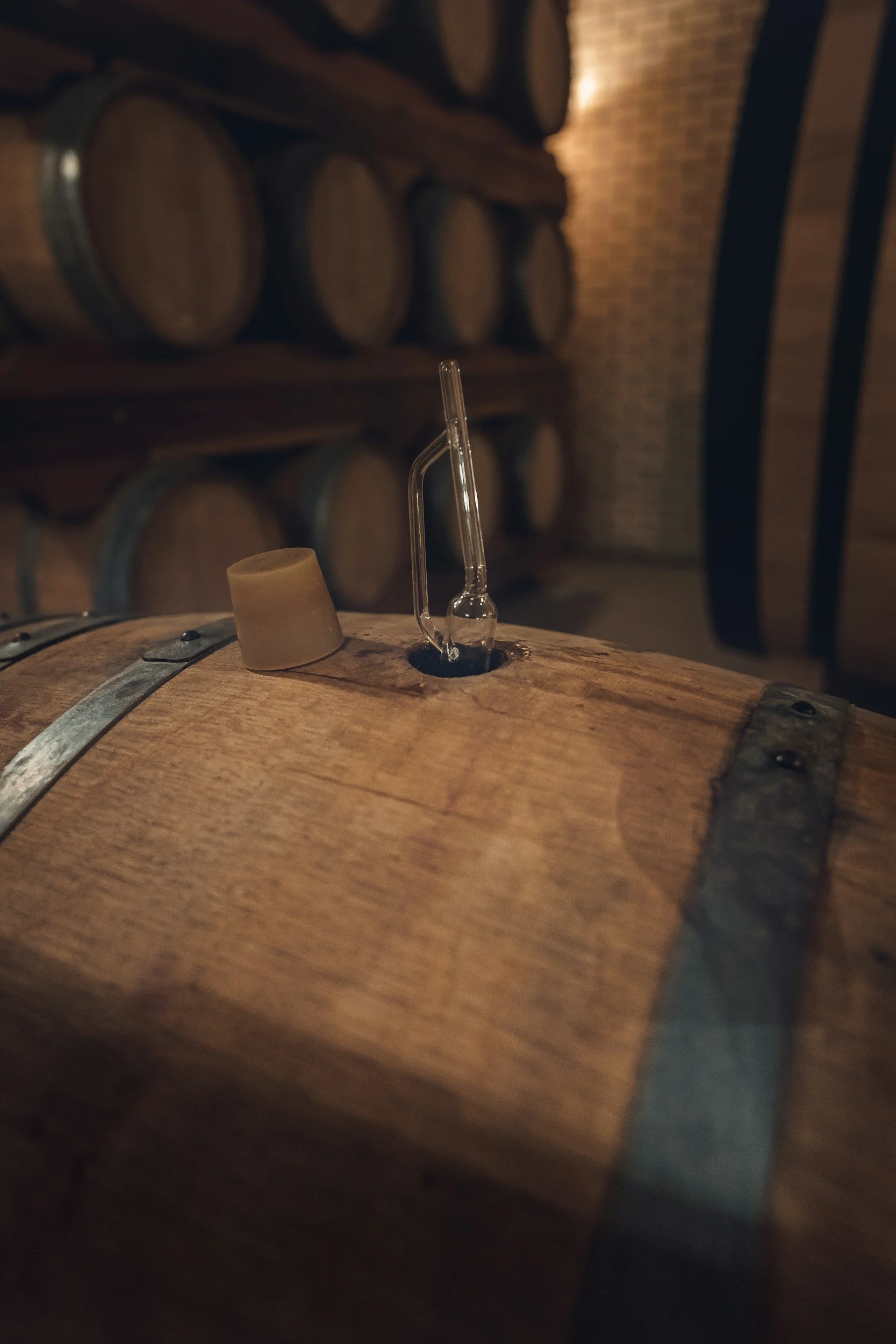
Oak program: frame, don’t mask
Calistoga Benchland Cab naturally gives:
blackcurrant & blackberry
graphite and dust
savory earth
So:
≤30% new oak equivalent if barreling
for carboys: 20–40 g oak chips/cubes to start, taste and step up
medium or medium+ toast French oak recommended
What to expect in the glass
blackberry and cassis
black cherry
cocoa and graphite
savory Calistoga earth
firm, age-worthy structure without harshness
Overall:
A cooler-year Calistoga Cabernet with real berry fruit, earth, and balance — and with the right early tartaric adjustment, it becomes beautifully stable, fresh, and cellar-worthy.